Catalogue No.: GP25
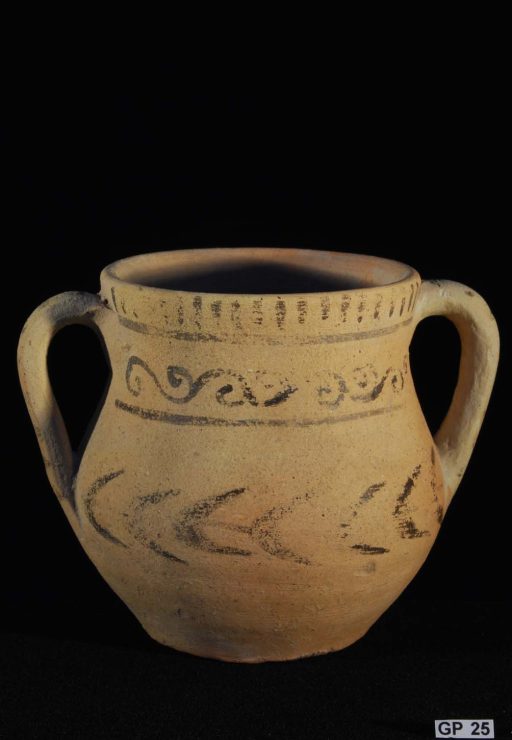
Catalogue No.: GP25
Title: Provincial Greek Fine Clay Cup
Date: 4th Century BC
Culture: Greek
Origin: Magnae Graecia
Material: Fine buff clay with pale red coloring and black-painted decoration
Dimensions: 113 mm (Height) x 86 mm (Diameter)
Description
This Provincial Greek Fine Clay Cup from the 4th century BC is a distinguished artifact from Magnae Graecia, the region in southern Italy where Greek settlers fused their artistic traditions with local Italian elements. Crafted from fine buff clay, the cup is characterized by its lightweight and smooth texture, which has been elegantly finished in a pale red hue. This subtle coloration sets a delicate backdrop for the cup’s sophisticated black painted decorations.
The design of the cup is a testament to the intercultural artistic dialogue of the era, featuring a striking combination of geometric and naturalistic motifs. Around the upper circumference of the cup runs a band adorned with meticulously painted banded and chevron patterns. Below this, the body of the cup is embellished with sinuous vegetal designs, which bring an organic movement to the composition, contrasting beautifully with the structured patterns above. This blend of geometric rigor and natural fluidity not only highlights the technical prowess of the artisans but also their ability to harmonize Greek stylistic elements with the more earthy and dynamic motifs preferred in Italic traditions.
The cultural relevance of this cup extends beyond its aesthetic appeal, serving as a physical representation of the syncretism that defined the ancient Mediterranean world. As Greek culture spread across southern Italy, it did not simply overwrite local traditions; instead, it intertwined with them, creating new forms of expression that were neither entirely Greek nor entirely Italic but distinctly Magna Graecian. This cup, therefore, is not just a vessel; it is a narrative of adaptation, innovation, and cultural integration.
Such an artifact is invaluable not only for its beauty and historical significance but also as a focal point for educational initiatives. It offers a tangible connection to the past, bringing to life the stories of ancient peoples and their interactions. For investors and collectors, the cup represents an opportunity to own a piece of this rich historical tapestry, promising not only aesthetic satisfaction but also a potentially appreciable asset in the realm of ancient artifacts. This piece, with its proven provenance and exceptional state of preservation, is primed to capture the imagination of all who appreciate the art and history of the ancient world.
Cultural Relevance
This cup is significant not only for its artistic merit but also as a cultural artifact that illustrates the hybridization of Greek and native Italic artistic styles. It exemplifies how local craftsmen embraced and integrated Greek aesthetic principles with their own, creating unique artworks that were distinct to the region yet reflective of broader Hellenistic influences.
Provenance and Legality Documentation
Provenance History
Crafted in the historically rich region of Magnae Graecia, this cup epitomizes the area’s complex cultural dynamics. According to the Victor M. Pracas Collection documentation, the piece is part of a well-documented lineage, having been acquired through reputable sources including major collections and family inheritances over several decades, ensuring a clear and legal provenance.
Legal Documentation
The cup has been verified for authenticity and legal ownership, supported by detailed documentation and expert evaluations, including certificates of authenticity that conform to international standards for antiquities. This ensures that the cup can be legally traded and exhibited.
Investment Consideration
This Provincial Greek Fine Clay Cup, as a rare artifact embodying the artistic and cultural synthesis of ancient Greece and Magnae Graecia, presents a significant investment opportunity. Its historical significance and the seamless integration of Greek and Italic artistic traditions make it particularly valuable to collectors and institutions dedicated to the preservation and study of ancient Mediterranean civilizations. The cup’s superb condition, coupled with its well-documented provenance, substantially enhances its potential for appreciation in value over time. Acquiring such a piece offers not only a touchpoint to the rich cultural narratives of the past but also a promising asset likely to accrue financial and educational value in the future. This makes the cup an astute acquisition for any serious collection of classical antiquities.
Exhibition
This cup has been a key exhibit in our museum, featured in displays that focus on the artistic and cultural exchanges in Magnae Graecia. It helps illustrate the spread of Greek culture and its adaptation in different colonial contexts, offering viewers a deeper understanding of the historical and artistic evolution of the region.
Educational Value
The cup serves as a valuable educational tool, facilitating insights into the craftsmanship, artistic styles, and cultural interactions of ancient Magnae Graecia. It provides a tangible link to the past, enabling a better understanding of how everyday objects mirrored the complex intercultural relationships of their time.
References
The entry is supported by academic research on Greek pottery in Southern Italy, highlighting the distinctive characteristics and historical importance of such artifacts. These studies enrich the narrative of the cup’s artistic and cultural significance, providing a comprehensive backdrop for its appreciation and study.