Catalogue No.: GP03
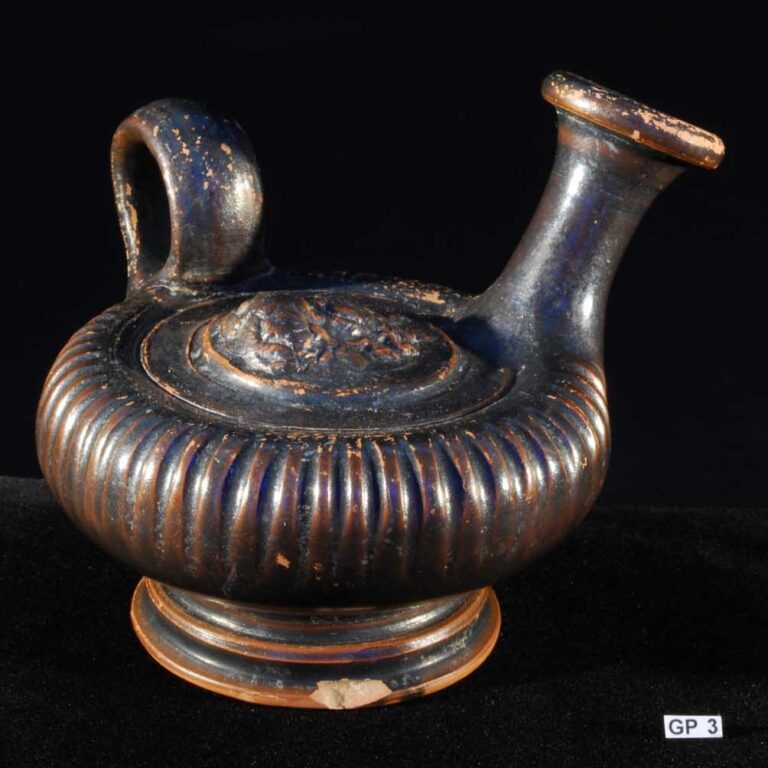
Catalogue No.: GP03
Title: Apulian Black-Glaze Guttus
Date: Mid 4th Century BC
Culture: Greek
Origin: Southern Italy
Material: Light terracotta with metallic black glaze.
Dimensions: 100 mm (Width) x 99 mm (Height).
Description
This Apulian Black-Glaze Guttus, dating from the mid-4th century BC, represents a pinnacle of ceramic craftsmanship practiced by Greek artisans in Southern Italy, a region noted for its seminal contributions to the Hellenistic pottery tradition. This guttus exemplifies the functional sophistication and aesthetic elegance characteristic of ancient Greek vessels, which were traditionally used for storing and dispensing precious liquids like oils and wines.
The guttus features a characteristically wide and stout body, segmented by ribbed detailing that not only reinforces its structural integrity but also enriches the tactile experience. This ribbing is both a practical and decorative element, suggesting a vessel designed for frequent handling and visual appreciation. The flared spout, meticulously crafted, ensures a controlled pour, critical for both ritualistic and everyday use where precision is paramount.
One of the vessel’s most striking aspects is the ornamental relief that decorates its upper surface, possibly depicting Pan, the rustic god associated with fertility and music, or a Gorgon, used as a protective emblem. This choice of imagery is laden with cultural and religious symbolism, integrating the vessel into the rich mythological tapestry of the Greeks and reflecting their use of visual narratives to express communal values and beliefs.
The application of a metallic black glaze over the terracotta base serves both aesthetic and functional purposes, sealing the porous material while accentuating the relief’s intricate details. This vivid visual contrast not only enhances the artwork’s legibility but also underscores the local adaptations of Greek ceramic techniques, showcasing the innovative spirit fostered by intercultural interactions within the Hellenistic world.
In its entirety, this guttus is a testament to the advanced technological skills and artistic foresight of its creators, who achieved an exquisite balance between utility and visual splendor. Well-preserved and rich in detail, this piece offers invaluable insights into both the daily life and the ceremonial practices of its era, making it a crucial artifact for understanding the cultural and artistic environment of ancient Greek-influenced Southern Italy.
Cultural Relevance
This guttus is a vivid emblem of the cultural and religious tapestry of the ancient Greeks, particularly evident in their Southern Italian colonies. The relief, possibly depicting Pan, the deity of wilderness and music, or a Gorgon, emblematic of protection, underscores the deep intertwining of daily utility with profound mythological significance. These figures were not chosen merely for their aesthetic appeal but for their rich symbolism associated with protection and fertility, themes deeply woven into the fabric of Greek mythology.
This vessel exemplifies the ancient Greek mastery of imbuing functional objects with significant cultural symbolism, transforming a simple container into a piece rich with artistic and ritualistic value. By incorporating such iconic imagery, the guttus served not just as a household utility but also played a role in the spiritual and protective practices of its time. It reflects a culture where art and utility were seamlessly integrated, serving to enhance the quality of both daily and ceremonial life, and where even the most common items were carriers of cultural identity and spiritual significance.
Provenance and Legality Documentation
Provenance History
The Apulian Black-Glaze Guttus was unearthed in a region of Southern Italy known for its rich Greek archaeological heritage, indicative of the widespread influence of Greek culture throughout the area during the 4th century BC. This particular artifact has been a part of the esteemed Victor M. Pracas collection, which is renowned for its rigorously documented and diverse assortment of ancient artifacts. Historical records indicate that the piece has been acquired through legitimate channels, with a well-documented lineage that includes prominent historical and private collections known for their lawful acquisition practices.
The Victor M. Pracas collection, from which this guttus originates, includes acquisitions from several notable sources such as the Paul Freeland Collection, R.J. Upland Esq. Collection, and Lanzoni Estate Collection, among others. These pieces have been collected over many decades, often transitioning from one renowned collection to another, which has helped maintain a continuous and verifiable provenance trail that substantiates the guttus’s authenticity and historical value.
Legal Documentation
The legal status of the Apulian Black-Glaze Guttus is secured by comprehensive documentation that confirms both its authenticity and the legality of its ownership. This includes detailed catalog records, expert appraisals, and certificates of authenticity that are cross-referenced with the broader collection’s inventory. Legal experts and antiquities specialists have conducted thorough assessments to ensure that the artifact complies with all relevant cultural heritage laws, including those governing the import and export of ancient objects.
Furthermore, legal reviews have been periodically performed to confirm that there are no encumbrances or legal constraints that could affect the ownership, display, or sale of the guttus. The artifact has been cleared for exhibition and sale, and it conforms to international standards regarding provenance and legality, making it a secure acquisition for any collector or institution.
Investment Consideration
This guttus constitutes a prime acquisition for collectors and cultural institutions, distinguished by its exceptional preservation, well-documented provenance, and the inherent artistic and historical value characteristic of Apulian pottery. The rarity of such an artifact, coupled with its exemplary craftsmanship, significantly bolsters its investment potential. In a market where the demand for ancient artifacts with verifiable authenticity remains robust, this guttus stands out as particularly valuable.
The meticulous detailing and rich symbolic imagery of the piece not only reflect its aesthetic and cultural worth but also enhance its appeal to discerning collectors and institutions focused on the Hellenistic period. Investing in this guttus offers the dual advantage of owning a piece of ancient art that is both a tangible connection to the past and a likely appreciable asset. Its presence in a collection can elevate the collection’s overall stature, making it an attractive and strategic choice for both private and public entities seeking to enrich their holdings with artifacts of substantial historical import and proven market desirability.
Exhibition
The guttus has been featured in several exhibitions focusing on ancient Greek ceramics, highlighting its role in daily and ritualistic contexts. It has helped audiences appreciate the functional artistry of Greek ceramicists and the integration of form and function in classical antiquities.
Educational Value
As an educational tool, the guttus provides insight into ancient ceramic production techniques, Greek mythological themes, and the daily lives of ancient peoples. It serves as a significant resource for learning about the diffusion of Greek culture across the Mediterranean, particularly in the context of its colonial interactions.
References
This entry is supported by scholarly literature on Apulian pottery, which discusses its stylistic features, production methods, and cultural implications. These references are crucial for understanding the importance of such artifacts in the broader narrative of ancient Greek art and archaeology.