Catalogue No.: GP47
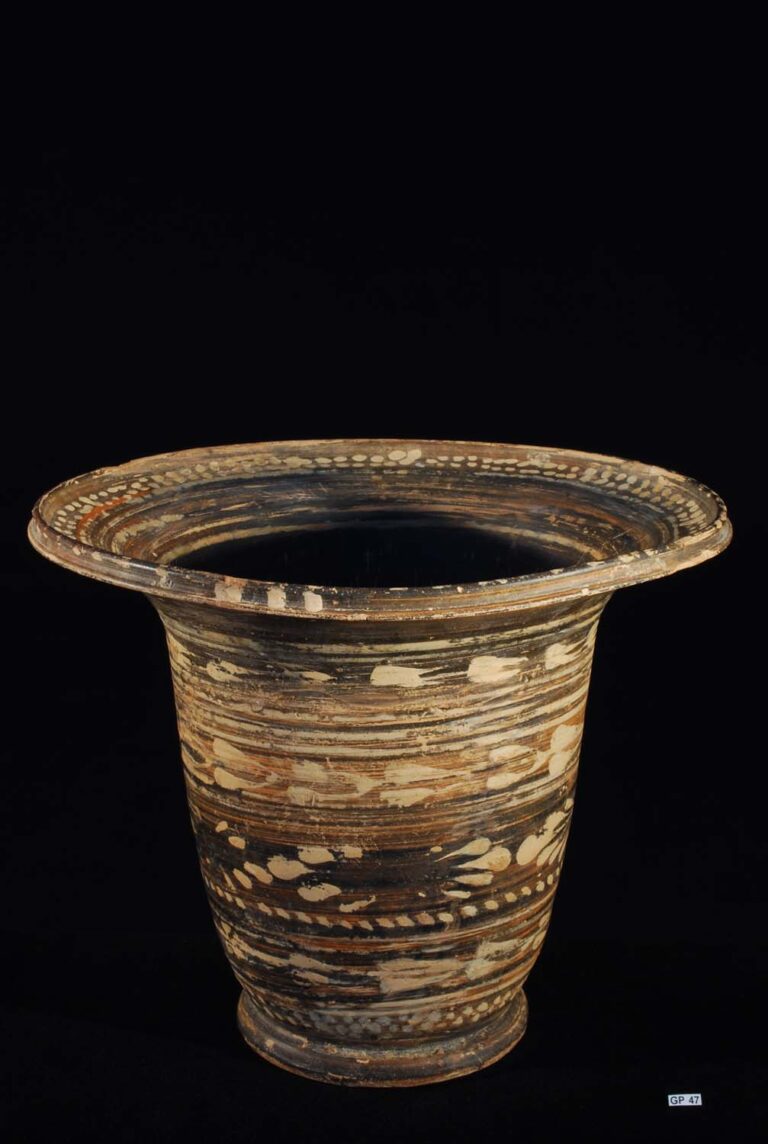
Catalogue No.: GP47
Title: Greek Messapian Painted Kalathos
Date: 2nd half of the 4th Century BC
Culture: Messapian
Origin: Apulia, Southern Italy
Material: Fine buff terracotta with applied mineral pigments
Dimensions: 240 mm (Height) x 205 mm (Width)
Description
This Greek Messapian Painted Kalathos from the second half of the 4th century BC is an exceptional showcase of ancient craftsmanship and aesthetic refinement, emblematic of the rich cultural fabric of Southern Italy’s Messapian civilization. Expertly crafted from fine buff terracotta, the kalathos features a wide-flaring bowl designed with a pronounced deep groove around its rim, enhancing both its structural integrity and visual allure.
The vessel’s body is masterfully adorned with decorative friezes applied in buff paint, presenting a series of evocative motifs such as laurel wreaths, tendrils, floral sprays, and dotted details. These are strategically arranged in horizontal bands against a streaky black and brown background, a color scheme that not only highlights the vibrancy and precision of the decorations but also adds a significant textural depth to the piece.
The choice of motifs—laurel wreaths and floral patterns—carries deep cultural symbolism, typically associated with fertility, abundance, and victory in ancient Mediterranean societies. These elements suggest that the kalathos may have been central in both daily and ceremonial settings, perhaps utilized during agricultural festivals or community celebrations to mark periods of growth and prosperity.
Functionally, with its expansive opening and robust handle, the kalathos was likely used for collecting or storing vital commodities like grains or fruits, crucial to the Messapian diet and economy. This integration of practical design and elaborate decoration illustrates a society that deeply valued the symbiosis between utility and beauty, reflecting a vibrant cultural life where art and functionality were seamlessly intertwined.
Moreover, the intricate potting, painting, and firing techniques evident in this kalathos highlight the technological sophistication of Messapian artisans, revealing their capability to create durable and detailed ceramics that have withstood the test of time. The exceptional preservation of this kalathos allows contemporary audiences to appreciate the millennia-old artistic traditions that have been passed down through generations.
As a bridge to the ancient past, this Messapian kalathos offers a profound glimpse into the cultural dynamics of ancient Southern Italy, standing as a testament to the artistic and technological prowess of the time. It serves as an invaluable piece for educational and cultural exhibitions and remains a coveted item for collectors and historians dedicated to the study of ancient Mediterranean art and culture.
Cultural Relevance
This kalathos is not merely a vessel of remarkable artistic merit; it serves as a vital window into the cultural and social fabric of ancient Messapia. Its design and function reflect the integral role that pottery played in the daily and ceremonial life of the Messapians. Used both for everyday purposes and in sacred contexts, the kalathos embodies the dual nature of many ancient artifacts, which were designed to be as practical as they were symbolic.
The decorative elements of the kalathos, notably the laurel wreaths and floral patterns, are particularly telling of the cultural values of the time. These motifs, frequently associated with divine protection and the celebration of life, underscore the Messapians’ deep reverence for nature and its cycles. Such symbols likely conveyed messages of growth, fertility, and prosperity—themes that were central to the agrarian societies of the Mediterranean and were often invoked during religious rituals and community festivals.
Furthermore, the presence of these motifs on a utilitarian object like a kalathos illustrates the seamless integration of aesthetic beauty and functionality, highlighting a society where art infused everyday life. This practice speaks to a cultural ethos where the beautification of utilitarian objects went hand in hand with their use in both public and private spheres, thereby enriching our understanding of how the ancient Messapians viewed the world around them. Through such artifacts, we gain a deeper appreciation of their artistic expression, as well as insights into the religious and social practices that shaped their community interactions and spiritual beliefs.
Provenance and Legality Documentation
Provenance History
Acquired as part of the Victor M. Pracas collection, this kalathos is documented to have originated from several notable collections including the Paul Freeland Collection and the R.J. Upland Esq. Collection, ensuring its traceable and reputable lineage.
Legal Documentation
The item has been rigorously authenticated and verified, with legal documentation confirming Victor M. Pracas’s ownership and the lawful provenance of the kalathos. It is free from any export restrictions, affirming its eligibility for sale and exhibition.
Investment Consideration
The rarity of this kalathos, paired with its meticulously documented provenance and superb state of preservation, establishes it as an exceptionally valuable asset for potential investors. Its historical and artistic importance significantly boosts its allure to collectors and cultural institutions that have a keen interest in acquiring and preserving ancient artifacts. This piece, originating from the ancient Messapian culture, not only offers aesthetic beauty and a glimpse into the past but also holds the promise of increasing in value over time due to its scarcity and the ongoing interest in Mediterranean archaeological treasures. The presence of this kalathos in a collection could greatly enhance the cultural and monetary value of that collection, making it a wise and potentially lucrative investment for both private collectors and public historical entities.
Exhibition
Currently on display in our museum’s esteemed collection of ancient Mediterranean artifacts, this kalathos is a standout exhibit that illustrates the rich artistic and cultural heritage of Southern Italy during classical antiquity. Its presence enhances the narrative of the exhibition by providing a direct connection to the sophisticated craftsmanship and aesthetic sensibilities of the ancient Messapians, showcasing the region’s significant role in the broader tapestry of Mediterranean history.
Educational Value
This kalathos serves as a pivotal educational resource, deepening the understanding of ancient Messapian ceramic techniques and cultural symbolism for students, scholars, and the general public alike. It is particularly valuable for academic pursuits in ancient art, archaeology, and anthropology, providing a hands-on experience that brings to life the intricate details of ancient craftsmanship and design. Through this artifact, learners can explore the societal values and daily practices of the Messapians, gaining insights into how art and utility were intertwined in their culture and how these elements reflected the broader social and religious structures of the time.
References
The provenance and authenticity of the Greek Messapian Painted Kalathos are well-supported by comprehensive documentation within the Victor M. Pracas collection. Detailed records, including the cataloging of each item and additional certificates of authenticity, have been meticulously cross-referenced and evaluated by K.A. Hicks & Associates. The item’s rich history of ownership, including its origins from notable collections such as the Paul Freeland Collection and R.J. Upland Esq. Collection, enhances its historical credibility. Additionally, scholarly research on Messapian pottery and cultural practices in ancient Southern Italy provides essential insights into the artifact’s significance and context