Catalogue No.: GP18
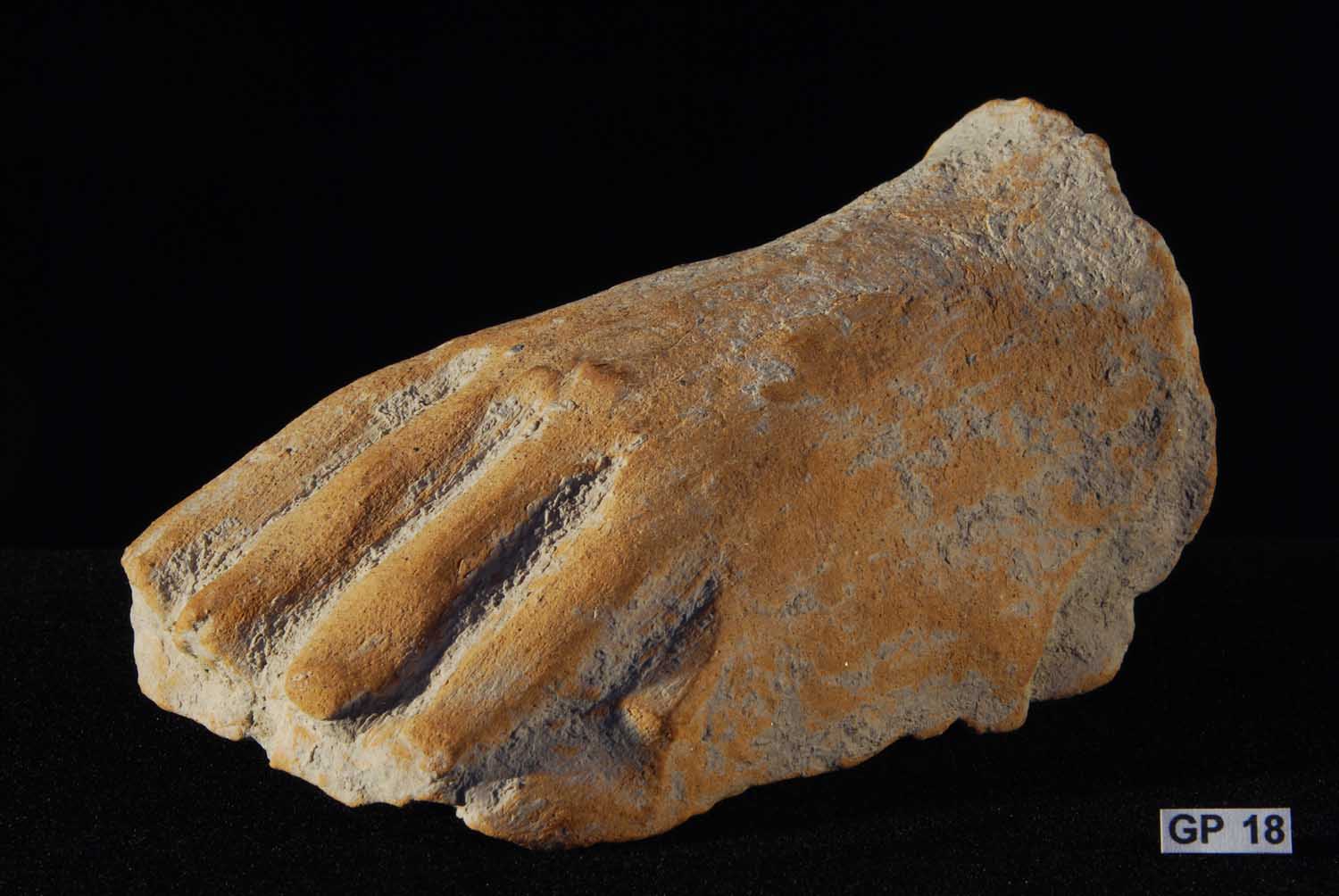
Catalogue No.: GP18
Title: Cypriot Statue Fragment – Left Foot
Date: Cypro-Classical Period (5th – 4th Century BC)
Culture: Cypriot
Origin: Cyprus
Material: Pink clay with slip coating
Dimensions: 110 mm (Length) x 59 mm (Width)
Description
This exquisite fragment from a terracotta statue, specifically the left foot of a larger figure, is a testament to the sophisticated artistry of Cypriot sculptors during the Cypro-Classical period (5th – 4th Century BC). Crafted from locally sourced pink clay, this piece is finished with a delicate slip coating that enhances its texture and highlights the subtle hues intrinsic to the material.
The foot, although a mere fragment of the original statue, is rendered with remarkable precision. The detailed delineation of each toe and the naturalistic curves of the arch capture the anatomical accuracy that Cypriot sculptors achieved, reflecting their deep understanding of human form. This attention to detail extends to the slight wear on the surface, suggesting that the statue was not only an object of artistic admiration but also played a functional role, possibly in religious or communal gatherings.
Furthermore, the hollow-moulded form of the original statue indicates advanced technical skills in ceramic arts during this era, allowing for larger and more complex figures to be crafted with considerable finesse. The smooth finish on this fragment indicates a high-quality slip coating technique, which not only preserved the statue but also accentuated its aesthetic appeal.
The survival of this fragment highlights its cultural and historical significance, suggesting that it was part of a statuary ensemble that was accessible and revered within its community. Such artifacts provide invaluable insights into the everyday and spiritual lives of their contemporaries, bridging past civilizations with the present through enduring expressions of artistry and worship.
Cultural Relevance
This artifact offers a glimpse into the religious and cultural life of ancient Cyprus, where statues played a significant role in both public and private devotion. The Cypro-Classical period was marked by significant Hellenistic influence, yet Cypriot artisans maintained a distinct style that mirrored the island’s diverse cultural interactions. As a fragment of a presumably sacred or communal statue, this piece highlights the religious syncretism and the local adaptations of broader Hellenistic artistic trends.
Provenance and Legality Documentation
Provenance History
Acquired from the esteemed Desmond Morris Collection, this Cypriot statue fragment is part of a well-documented lineage, ensuring its historical integrity. The artifact reflects the legacy of Cypriot craftsmanship during the Cypro-Classical period. The documentation provided by the Desmond Morris Collection and further verified through additional provenance research confirms a clear and legitimate chain of ownership, enhancing the artifact’s value and historical significance.
Legal Documentation
This artifact has been subjected to rigorous provenance research, confirming its compliance with all international cultural heritage laws. It has been legally acquired, with comprehensive documentation supporting its authenticity and legal ownership. Necessary permits for its export from Cyprus have been duly obtained, ensuring lawful transfer and sale. The statue fragment’s legal status is further reinforced by its inclusion in well-regulated transactions and collections, affirming its availability for acquisition and display without legal encumbrances.
Investment Consideration
This Cypriot statue fragment, hailing from the esteemed Desmond Morris Collection, represents a significant acquisition for collectors and institutions alike. Its historical value, rooted in the rich cultural backdrop of the Cypro-Classical period, combined with rigorous documentation confirming its authenticity, renders it a highly desirable piece. The artifact’s inclusion in a renowned collection not only bolsters its appeal but also assures potential investors of its verified provenance and legal standing. As the market for ancient artifacts becomes increasingly discerning, the unique attributes of this piece—its historical context, craftsmanship, and association with a noted collector—substantially enhance its potential for appreciation in value. This fragment is not merely a relic of the past but an investment in a tangible piece of history, likely to accrue value both as a cultural and financial asset.
Exhibition
This item is displayed in our museum’s collection and has been featured in exhibitions focusing on Cypriot antiquities, illustrating the unique cultural heritage of Cyprus and its interaction with ancient Greek traditions.
Educational Value
This artifact, a Cypriot statue fragment, serves as a powerful educational resource, enriching our understanding of sculptural techniques and materials used in ancient Cyprus. It provides a direct, tangible connection to the Cypro-Classical period, facilitating deeper exploration into the art and culture of the Mediterranean region. By studying this piece, students and visitors can appreciate the craftsmanship involved in the creation of such sculptures, including the specific types of clay and decorative techniques employed by Cypriot artisans. Furthermore, this fragment acts as a springboard for broader discussions about the social, religious, and economic contexts of ancient Cypriot society, offering insights into how these influences shaped the artistic expressions of the time. Through its display and interpretation, the fragment not only educates about the past but also stimulates curiosity and fosters a deeper appreciation for the cultural heritage of Cyprus, making it an invaluable component of our museum’s educational offerings.
References
The artifact is well-supported by scholarly research, with citations from studies on Cypriot art and archaeology, providing a deeper understanding of its historical context and cultural significance.